Friday, January 24, 2020

Mr. MacKenzie - Curriculum Newsletter


Introduction
This has been a very busy year to this point. The students have improved in their mathematical reasoning and in their ability to craft engaging writing for a specified purpose and audience. This newsletter is divided into sections for the various content areas. Each section presents a brief description of our journey so far, followed by our next steps.

As always, if there are questions, concerns, or comments please call or email.

Sincerely,
Mr. MacKenzie
MHMacKenzie@cbe.ab.ca
(403) 817-3576

Mathematics

Grade 5: The students built an understanding of measurement. They used rulers, measuring tapes, and measuring cups. Through hands-on learning opportunities, they converted areas of measurement. Furthermore, students began thinking ‘algebraically’. For this, they used input/output tables (patterns) to create rules and expressions. Knowledge of the operations were required for this, as were problem solving skills.
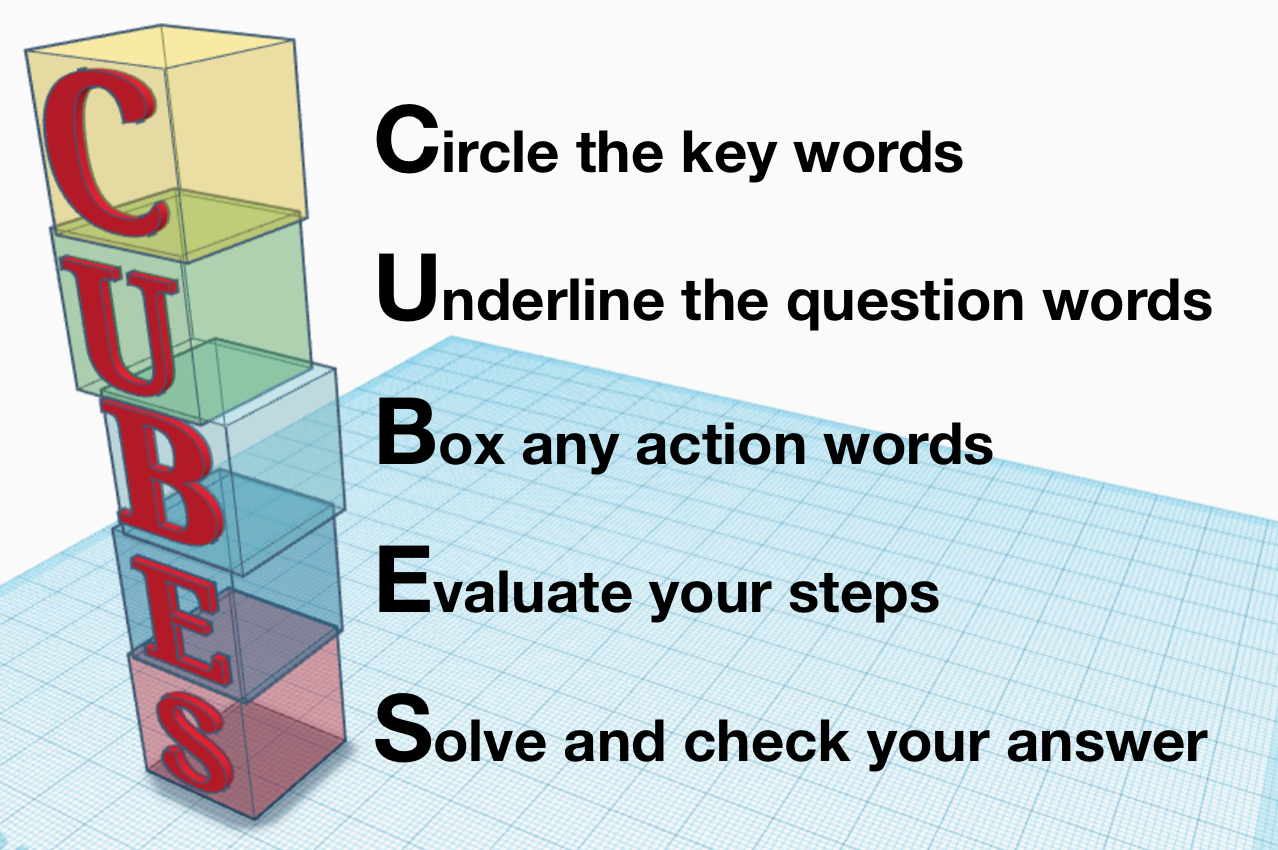

The students will be using the CUBES strategy (above) to solve word problems and to aid in their test-taking skills. In the upcoming term, students will examine the relationships between operations and will practice multiplying/dividing large numbers. Furthermore, students will explore decimals and fractions in a variety of contexts.

Grade 6: The students constructed 3D shapes of varied types and sizes. Through measurement, they calculated volume, area, and perimeter. Students were challenged balance equations and to conserve equality (6t = 10-4 is the same as 6t-1 = 10-4-1). They also used patterns to deduce expressions with two operations.

In the upcoming term, students will explore the operations in depth. They will also learn about prime numbers and factoring. As they do, the CUBES problem solving strategy will be used to help them understand the connected and relevant parts of a question. They will also be taught to review their work and to check their answers.

Science
Grade 5: The grade 5s studied electricity through creating an electronic game and a flashlight. They also studied weather in depth through researching cloud formation and exploring the movement of air within our troposphere. The students then constructed weather measuring devices (an anemometer for wind speed, for example). Through measuring the local environment, students were able to draw conclusions between Earth’s systems and the world they experience daily.

Chemistry and wetlands await the students as we carry on with our scientific investigations. The students will explore different types of mixing, and will experience a number of chemical reactions. The biologically diverse wetlands are nature’s filtration system. Students will examine the animals and plants that thrive there, and will explore their necessary adaptations.

Grade 6: The grade 6 students have been studying air and aerodynamics, as well as flight. For this, they explored the properties of air and constructed a range of airplanes. We used experiments and demonstrations to explore Bernoulli’s principle. Through exploring air as a fluid, students were able to draw conclusions about why things float or fly through the air. This topic will be reviewed as the Provincial Achievement Tests approach.

The upcoming unit of study is Sky Science. Students will expose constellations and the interactions between the sun, the moon, and the Earth’s systems. They will also construct an interactive video game for a planet that they choose to research. After Sky Science, the students will study Evidence and Investigation.

Social Studies
Grade 5: The grade 5s have been studying the stories and people who contributed to the construction of Canada. Beginning with confederation, the students examined the impact of the Canadian Pacific Railway, The Fathers of Confederation, and the Famous Five - to name a few topics. They have created beautiful books detailing this learning journey. Through the lens of “Power”, the students have also had incredible, in-depth conversations.

We will continue exploring the building of Canada’s identity, and we will look closely at the physical geography of Canada. Namely, why do we have national parks? The students will take on the role of marketing specialists, as they create advertisements for different regions and parks within Canada.

Grade 6: The grade 6 students have examined politics in Canada and within Ancient Athens. During the federal election, students engaged in a number of debates and persuasive writing tasks. They examined each party’s platform and took a deep dive into varied current events. Afterwards, the students constructed exceptional books where they took a close look at Athenian Democracy - which is where democracy began.

Students will now examine the Iroquois Confederacy. This will provide interesting discussions as they compare and contrast the democratic models they are familiar with. Afterwards, the students will begin analyzing their Local Government, and we are hoping to have a city councilor swing by for a visit!

Literacy
Literacy was integrated between the grade 5 and 6 students. Each group examined texts through the lenses of ‘power’ and ‘empathy’ and wrote newspaper articles connected to various topics. For example, they wrote a newspaper report on the Giver and  the Australian wildfires. Further, they managed information and ideas through developing venn diagrams, timelines, and cause and effect visualizations. This was beneficial as they synthesized their learning.

After looking at persuasive language and debate, the students began looking at functional (newspaper) writing. Through constructing effective lead sentences and practicing organization, the students became more intentional with their writing.

Students will now look carefully at narrative writing. To improve their writing skills, they will engage in the writer’s cycle. The writer’s cycle includes planning, drafting, revising, editing, and ends with publication. We will publish through printing our work and binding books of our own. We will also construct a digital portfolio, in which to share our writing.

Conclusion
It has been an exciting school year so far! There is a ton of learning to come. Please make sure to check Iris regularly, as it is a forum for communication between teachers, students, and parents.

Also, don’t forget that Feedback Friday is going home every Friday! And while we want the students to take ownership, they may require assistance and reminders to complete their assigned tasks.

All the best in 2020!
Mr. MacKenzie


Friday, January 17, 2020

Scientific Concept Books

The last two weeks since coming back from Holidays has been busy (which is a bit of an understatement). Between getting back into routine and enduring days of indoor recess we are all ready for this weekend.

The cold weather may have slowed down our recess but it hasn't slowed down our learning! Students have begun studying new units in Science. Grade 4'5s have been learning about Simple Machines and the Grade 5's are looking at Weather.


We began our unit by exploring some of the things we will be learning about. The Grade 4's learned about levers by building first, second and third class levers and the Grade 5's began to recognize the different types of clouds through a detailed guided drawing.

From there we began learning some key terms. To organize our thoughts and these vocabulary terms we have made small books that we can add information into as we learn it. That way it's all in one spot and we can reflect back upon it at any time.


Grade 5's will be recording the clouds that they see each week as they learn about how they are made, where in the atmosphere they are located and what weather they produce. 
Grade 4's will continue to learn about how different machines are made and will be building their own simple machines that will help them in their everyday life!

Stay Tuned....


Monday, December 16, 2019

Exploring the Regions of Alberta and Canada


This term we have been learning about the different regions within our Province and our Country.
Grade 4's have spent time learning about the different regions within Alberta, the Natural Resources that are found within them, the climate and the landforms.
Grade 5's have been learning about the regions of Canada, the Natural Resources, the climate and the landforms in the regions.


Each grade level has spent time researching on different websites, taking notes and sharing the information that they have gathered. It has been a great way for us to learn how to properly search websites for accurate and appropriate information and how to manage that information.
We have watched videos based on stories of people that live within the different regions. These stories help us to understand how the resources within the region help to bring people their and sustain their city/town/province.
We learned about what happens when those resources are longer there by learning about Ghost Towns.


This unit has allowed us to become experts in the different regions and  has also been a fantastic introduction into what we will be learning about after the break. As we start to learn about our history, the people that made our province and our country we will understand the conditions to which they lived and the places that they travelled.


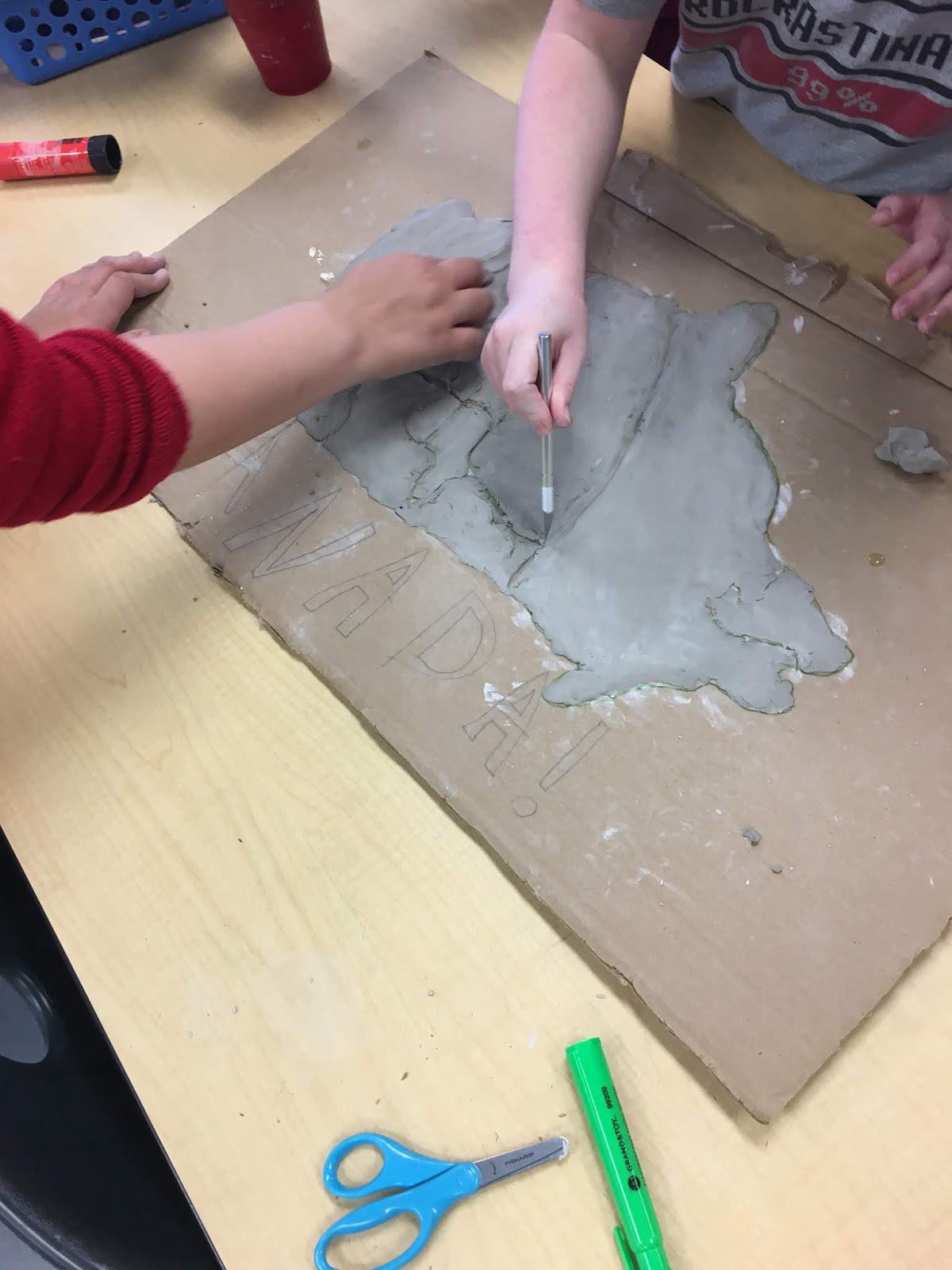
This coming week we are taking everything that we have learned and we are making topographical maps based on our Grade. We can't wait to put it all together to share with everyone in the school!


Sunday, December 15, 2019

Mr. Wideman (Room 104) - Dec 9 - Dec 13

The students in Room 104 have been working hard to finish several of our assignments and projects before the end of the month. The final week before the holidays is almost here, and we have some fun and exciting activities planned for the upcoming days:

Monday - Favourite Sweater Day
Tuesday - Holiday Hat Day
Wednesday - Dress The Same Day
Thursday - Pajama Day - last day of school for students
Friday - PD Day - no school for students

Our work in Language Arts has been connected to our Invention Convention projects in Science, as each student group has completed writing their presentations to share their invention and the real world problem that their designs intend to help solve. Each group included students from both Grade 4 and Grade 5, and this gave us the opportunity to combine our knowledge and understanding of both electrical circuits and waste management to build a model of our invention using our collective designs. During the upcoming week, each group will present their work via Google Slides, as well as a live demonstration of their inventions, and the class will gain a deeper understanding of the ways in which each design helps to solve a critical question related to waste management within the City of Calgary.


Through working with Tinkercad, our students continue to explore the elements of planning for design purposes. By incorporating aspects of measurement, converting units, and properties of 2D and 3D shapes, our work with designing practical, but creative, supply containers has helped us to understand the importance of the role that these mathematical concepts play in the design process. Students in Room 104 are evaluating their designs as we investigate the results that our 3D printing has produced, and we're finding that even with accurate measurements, our final products don't always fully match the results that we intended. During the upcoming week, this will continue to lead us into further evaluations and redesigning of our plans for our projects.


Our student teacher, Miss Yanko, has completed her first classroom practicum with us, and she will be returning to Room 104 for March and April 2020. During her time with us, Miss Yanko led several of our lessons in Social Studies, Language Arts, and Phys Ed. We would like to thank her for all of the hard work and support that she demonstrated within our learning community. We're looking forward to having her return in a few month's time.

With all of the excitement that tends to come along with the final week of school, we'd like to remind students to continue to demonstrate the values of empathy that we've been discussing regularly in the classroom, as well as in our family groupings. While many of us have fun and exciting activities planned with family and friends, the holidays can be a difficult time for some of us too. By understanding the different feelings and perspectives that the holidays bring, we can all gain a better understanding of each other as well.

Take care, and enjoy the upcoming week!

-Mr. Wideman


Friday, December 13, 2019

December 13, 2019

Parents,
What a busy and outstanding week! The students have been digging deep into their learning. Below are the subject areas and some key learning notes about what we have learned so far, and where we are going. All the best, and have an outstanding weekend!

Mathematics:
We have been learning about pattern rules in math. For this, students have been looking at input/output charts. There are additional practice questions available within our class google drive.

Essentially, the students are learning to think algebraically. For example, if we look at the expression 2 x n + 5, we can input any number for n and arrive at an answer. If the value of n is 3, we would multiply 2 x 3 = 6. Then we would add 5: 6 + 5 is 11. In the upcoming week, students will continue unpacking the difference between an expression (2n + 5) and a pattern rule (the output is increasing by 2).

Literacy:
The students have been learning how to create engaging and impactful lead sentences. They learned a few strategies including using a question, using a quote, and using strange or unusual facts. We practiced through examining the book we are reading as a class, The Giver, and writing headlines for different important parts.

In the upcoming week we will continue with this work. I have noticed that many students are writing in run-on sentences still, and so we will need to take a step back and look at different types of sentences. We'll connect this to coding, to The Giver, and to newspaper writing in general.

Science: The grade 5s have been researching clouds for their upcoming cloud guide project. They are looking at different ways to classify clouds. This week, they will begin creating their cloud guide and they will learn about different ways clouds are created.

The grade 6 students are continuing to learn about air and aerodynamics. They have been studying Bernoulli's principle, and they have been learning about oxidation and the carbon cycle.

Social Studies: This is the work that came home today. The students have been constructing and understanding about democracy in Ancient Athens (grade 6) and building a Canadian Identity (grade 5). For this, the students have been constructing "Chap Books".

Have an outstanding weekend, and be sure to check the school website for all of the amazing events planned by the leadership club!
All the best,
Mr. MacKenzie

Monday, December 9, 2019

Science Exploration

Our Science over the last couple weeks have given students the chance to further their knowledge in multiple areas.

Grade 4 

Grade 4's have been learning about lights and shadows. We have been experimenting with a variety of materials to determine what is transparent, translucent or opaque. We have been investigating the difference between reflection and refraction through the experimentation process. Ask your child what the difference is and an example of each. The Grade 4's have been enjoying the hands on activities throughout this learning process. These activities have allowed the Grade 4's to understand how these concepts work and feel the different materials that interact with light.
Of course, the snowy weather put a damper on some of our fun with shadows but we made due! Instead of going outside to experiment with our own shadows we made our own shadow people out of tinfoil and used the flashlights to act as sun as we learned how shadows are made and how light impacts the size, shape and location of a shadow! Make sure to check out our IRIS pages for our videos we made. Students have one more final project where we will be combining all of our knowledge to make an optic device. Stay tuned....


Grade 5

Grade 5's have been working on an all encompassing project to learn about the Wetlands. Each student was assigned a wetland that they are becoming experts in. We spent time researching our wetlands and looking and pictures or watching videos to help us become experts. We then wrote a research paper to show how we manage and evaluate information. We then teamed up with experts in other wetlands to make a beautiful mural showcasing the beauty of our wetlands. Students will next take their knowledge of animals in their wetland to make a lifecycle of one specific animal and a quick writeup about why they are essential to their wetland. We then get to make our animal on the 3D printer!!! Next week we will be teaching each other, the Grade 4's and hopefully other students at Ron Southern about our wetlands. Make sure to ask us what we have learned!


Sunday, December 8, 2019

Mr. Wideman (Room 104) - Dec 2 - Dec 6

We hope that everyone is getting a chance to be outside enjoying the sun and the (not too cold) weather conditions. The upcoming week looks decent temperature-wise, but we encourage all families to ensure that students arrive at school with a warm coat, hat, and gloves. As we know, the wind chill here in Calgary can make things feel especially cold outside! For any misplaced items at school, chances are that they can be located in our school lost and found. The holidays are just around the corner! Please note that Thursday December 19 will be the last day of classes for our students. Friday December 20 is a Non-Instructional Day at Ron Southern School.

We concluded our creative story writing with a partner review/edit, and we shared feedback about the strengths of our writing, as well as areas for further growth and improvement. These stories are available for review at home through Google Drive. We know that many of our students had an opportunity to work on these stories at home and have a parent review their work with them, and we definitely appreciate your support. If you were unable to locate the editing checklist through Google Drive, please take a look at the following:

The checklist follows the same template that we used for our Pixar writing, so the students have used this format for editing previously. Our next steps in writing will take us into research and report based projects, and our investigation of the Pacific Northwest Tree Octopus helped to develop our understanding of the importance of critical exploration and questioning the accuracy of online resources. As we continue to conduct research on Alberta's regions and the physical regions of Canada, we'll be spending time conducting fact checking and comparing resources in order to ensure that we're locating information that is both accurate and useful for our purposes.

Our exploration of multiplication and division approaches and strategies will continue this week, and some of the work that we sent home in our yellow Weekly Review folders demonstrates the "Big 7" method for division. We included a video in last week's blog post that demonstrates this method, as well as several others that we'll be exploring over the next week. Our goal is for students to come away with one strategy that makes the most sense to them, as they should be able to explain how their chosen method works and why it's the best method to add to their personal bank of math strategies. If you'd like to review another video that demonstrates the Big 7 Method, please check out the following:


In Science, we're wrapping up a combined grade 4/5 project that brought us back into the worlds of Electricity (Grade 5) and Waste Management (Grade 4). In mixed grade teams, our students are planning, designing, and building models of inventions that function to help solve a real world issue around waste management for the City of Calgary. Within each team, the Grade 4 students bring their knowledge of Waste Management, while the Grade 5 students apply their understanding of electricity, switches, and circuits. The project involves both the design of a electrical powered prototype, as well as a presentation to be shared that describes the purpose and the practical function of the design. Stay tuned for the final reveal of these projects!

Thank you for your continued support. Enjoy the upcoming week!

-Mr. Wideman